Loading...
Loading...

A look at the tennis legend who dominated the grass courts of Wimbledon.
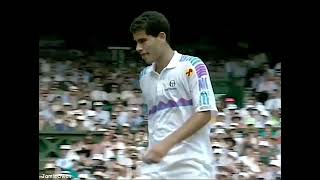
In the pantheon of tennis greats, Pete Sampras is often remembered for his quiet demeanor and his lethal serve-and-volley style that left opponents scratching their heads and audiences clamoring for more. Born on August 12, 1971, in Washington, D.C., Sampras grew up in California, the land of tennis sunshine and surfboards, where he began crafting the game that would eventually earn him a record 14 Grand Slam singles titles.
But let's not kid ourselves. His dominance at Wimbledon is the stuff of legends—or rather, the kind of material that makes other legends look like mere mortals. Between 1993 and 2000, he won an astounding seven Wimbledon titles, a tally that would make any lawn envy its own grass.
Here's the thing about Pete's serve: it was more than just a delivery—it was an event. Opponents might as well have brought a sleeping bag, because the Sampras serve was a wake-up call that left them groggy and disoriented. Clocked at speeds that defied physics and expectations, his serve became not just a weapon but a psychological edge, a kind of tennis hypnosis that had players questioning their career choices.
The 1993 Wimbledon final against Jim Courier was the defining moment. Sampras's serve was unstoppable, and by the time the grass stains had settled, he had secured his place as the new king of SW19.
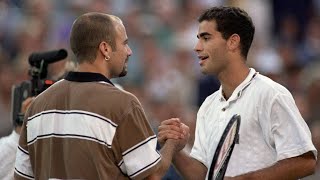
In sports, rivalries bring out the best—and sometimes the worst—in athletes. For Sampras, that foil was Andre Agassi, his fellow American with the charisma and the hair. Their contrasting styles—Agassi's flamboyance against Sampras's stoic professionalism—were like tennis's version of a buddy cop movie where nobody wants to be the comic relief.
Their epic clashes, particularly the 1995 US Open final, were battles of wits and wills, with Sampras often emerging victorious, much to Agassi's chagrin and the delight of fans who appreciated a good, old-fashioned duel.
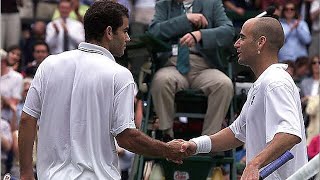
So, why do you retire when you're at the top of your game? For Sampras, it was a graceful exit on his own terms. After winning the 2002 US Open, defeating—you guessed it—Andre Agassi, Sampras decided to hang up his racket. It was a move that surprised many but also seemed fitting for a player who had always let his game do the talking.
His retirement wasn't a curtain call; it was more of a graceful fade into the sunset, leaving fans to wonder what could have been had he continued. But perhaps that's the point—to leave the audience wanting more, to be remembered not just for the wins but for the way he achieved them.
So, what does a retired tennis great do? In Sampras's case, it's enjoying life with his family and occasionally gracing the seniors' circuit with his presence, just to remind everyone he still has it. He's not chasing endorsements or hamming it up for the cameras—he's living the low-key life he always seemed to crave.
Sampras, now in his mid-fifties, remains a fixture in tennis lore, still inspiring the next generation of players who grew up watching his matches with wide-eyed wonder. His legacy isn’t just in his titles but in the quiet dignity with which he carried the mantle of greatness.
How loud do you turn Pete up?
Swipe to turn it up
Log in to vote
Sign in to join the discussion
 Sport
A journey through football's twists and turns
 Sport
A look at Semmy Schilt's legendary career
 Sport
A master behind the stumps and at the crease
 Sport
From Iowa to NBA Glory
 Sport
The journey of a boxing heavyweight
 Sport
From the indies to the big leagues and back
 +0,02